All posts by contact@sixplusholdem.com

poker-apps-sixplus-play-now

Why are Poker Apps so popular?

If you haven’t heard about Poker apps in 2020, chances are you are either a beginner or just old-fashioned. Jokes aside, it’s never too late to learn about something new and try it out. I could also totally understand if your not keen on playing under a so called „agent“ that handles deposits and withdrawals for you and such things that involve trusting the individual. But that’s the way they operate, since there is no major network like Pokerstars involved. PS and other big sites have a mobile apps as well, but this article is about a very different system which mostly operate as a „play-money“ app, turned into a real-money app by their users. Most of these are based in Asia, but generally it’s a world-wide network and they are played almost as a private home game would play, so to speak. Let’s start from the beginning to give you a better understanding of how this Poker app system works.

What do i need to know, before playing on apps such as UPoker, Pppoker or PokerBros?

What games are offered?

NLHE and PLO are offered in every club, but there is also plenty of action for 5-Card PLO, Open Face Chinese Poker (Pineapple) and only recently 6-Card PLO as well. Short Deck is also offered in some, but has yet to find its way into every club. At the bottom page we’ve added a link to a spreadsheet of the clubs that currently offer Short Deck games with traffic. We’ll have this sheet updated and will hopefully be able to offer you more options very soon.

How do I get money in and out?

There are no cashiers in the client itself, you are dealing with a group or person (agent) that is the middleman in getting your money in and out of the app. This means you are playing with virtual currency, coins/chips that have different value depending on the club you are joining. Make sure you can trust your agent and find out if they guarantee the money, assuming that club is ever going bankrupt. The chip value depends on the club you are playing in, for instance there are clubs based in Thailand that have 1 chip that equals 10 THB (Thai Baht). So if you join a 10/20 table, you are playing a $3/$6 game (NL600), because 200 THB is around $6. Other clubs have a 1:1 ratio in chip value and are played in USD. Either way, you will quickly get used to this system and before you get started, we will give you all the info needed.

How do I join a private club?

After you have opened an account on the app, you are not directly part of any game. You will need the club ID from your agent, which allows you to apply for this club and you will then be approved and can request chips from your agent to start playing. Sometimes you will come across a “Union” – A collaboration of a few clubs that merge their player-pool to gain more traffic. Basically, anyone is able to open a club, but it is very difficult to find the players that keep it running over a long time and build a network. Oftentimes, the action dies down once there are no more recreational players, which is the key to a long lasting club with good traffic.

Do I have to play on mobile?

Most apps are made for smartphones or tablets that run on android or iOS, but some have developed a windows based software which allows you to play on your computer as well. If the app of choice doesn’t support windows, you can use an emulator but it’s not the easiest thing to set up and might require a VPN as well, if you are looking to play on some Asian based apps/clubs. However, most apps won’t require you to use a VPN.

What are the risks?

Playing on apps is certainly not risk free. For one, the club you are playing on could “go broke” or the agent could make a run for it with the players’ money and this happens every now and then. That’s why it’s important to have a trustworthy agent. Another downside is the colluding, while many of the better clubs do everything they can to fight this issue, it’s still around in some clubs. But to be honest with you, most of those who collude are still players you will profit from in the long run, to say it nicely. 😉

Why should I give it a try?

Now, the above mentioned might not get you very excited to give one of these apps a try, but let me tell you the main reason you should. It’s a goldmine. Well, if you get the chance to play in the right club that is. It can be extremely soft and this is the case for most stakes. I’m not saying that any club will be like poker in 2010 all over again, but they do exist. Generally speaking, there are a lot less good regs compared to other major networks, especially for a game like Short Deck/6+ which is still very new to the majority of poker players. Say goodbye to bumhunting.

Rakeback PLS?

Is there any rakeback? Yes, most clubs do have rakeback for their players, but it’s very dependent on the club and how much the owner is giving away to the agent. Some clubs with very soft games don’t offer RB at all, but that’s not the norm. If a club offers less RB, it might be worth checking it out because you can expect less RB grinders and more recreational players (just my two cents).

app-tracker-h2n-shortdeck

Can I use a Poker tracker or HUD?

Some apps offer a simple HUD or a better version for paying customers. It’s also possible to have a 3rd party tracker such as Hand2Note, which is one of the better options. If you don’t have a subscription yet, you can use our promo code upon registering on Hand2Note. Promo code: H2N10JKPS gives 10% discount for the first subscription purchase with H2N.

How do these apps make money?

As mentioned before, most of these apps operate as play-money apps and that’s the reason you will find clubs on the same app played in different currencies, it’s ultimately the club owners’ decision. But how do these apps make money? They offer in-app purchases that will give you longer/more timebanks, a HUD or more detailed stats for example. If you want to run a club, you have to purchase the chips for your players. It’s a system that generates money for everyone involved. The app owner(s) are obviously making the most money here, second in the hierarchy are the club owner(s), then the agent with the best RB deal, then the sub-agent, and so on and so forth. You get the gist.

Conclusion

By now you should know the essentials of how this unique poker app system that has started a couple of years ago operates. Make sure you ask your agent of choice to explain all the details to you, since you might come across minor differences in terms and conditions of the app/club. 

If you want to give these games a try just contact us via our e-mail or in our discord channel. Below under ‚Poker App Deals‘ we have listed all of the current clubs we have available, together with all the info needed such as RB, Stakes, Rake, Games offered, etc. We will keep that document updated. Rest assured, we only work with trustworthy agents that guarantee your funds so it’s basically a risk free grind. Deposits and Withdrawals can be made via all common payment options.

Volume 4 (Multiway All-In)

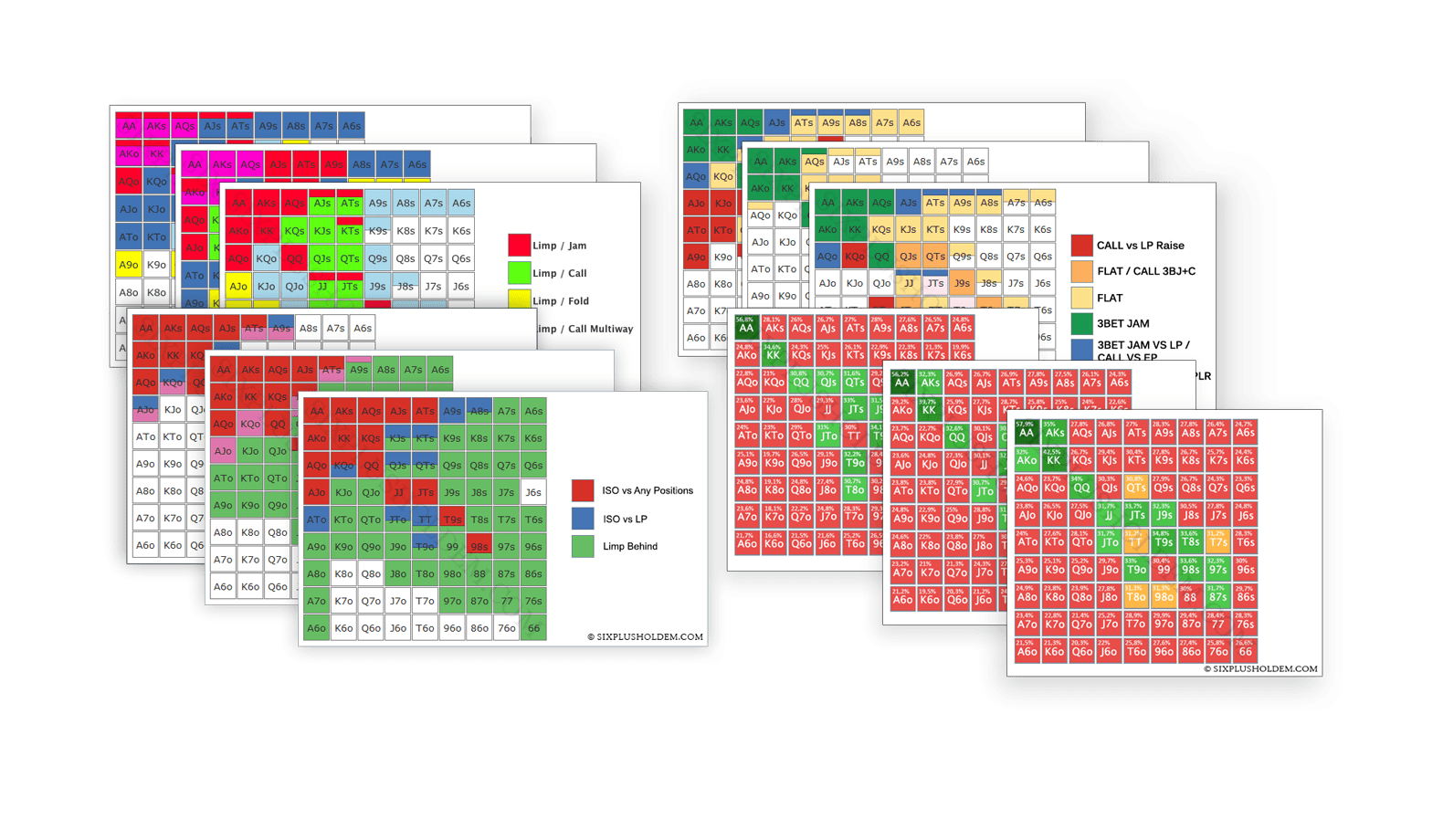
This volume includes some very valuable strategy including charts that cover 3-way and 4-way all-ins, which basically happens in almost every session. It’s essential that you know how much equity you have in these spots and which hands make a profitable call and which are -EV and should be folded. We have added equity to every possible starting hand in different scenarios, such as vs a standard shoving range, vs a wide range, vs a tight shoving range of both villain and vs a tight shoving and standard overcalling range.

While you still have to think and make adjustments while playing, these charts will help you improve your game, fix leaks and move up in stakes quickly.

The charts contain optimal preflop decisions that are based on population tendencies from a database of ~ 1 million hands. We created the charts for 5-6 handed plays with 100-200 ante stacksize.

Chart example:multi-way-all-in-sixplusVol.4 features:

  • Four hand charts for 3-way all-ins” & two villains range per chart (vs standard shoving range, vs wide shoving range, vs tight shoving range of both villain 1 and 2 and vs tight shoving and standard overcalling range).
  • One hand chart of 4-way all-ins” & three villains range (vs standard ranges of all 3 villain).
  • Four page guide with valuable strategy content, chart explanation and hand examples.

After purchase you will be able to instantly download a PDF file which includes all charts + strategy. Use either PayPal Wallet, BTC, VISA or Mastercard.

Starting Hand Charts Vol. 4

Starting Hand Charts Bundle (Vol. 1 +  2 + 3 + 4)

If you wish to pay with another payment method, please get in touch with us via email at: contact@sixplusholdem.com. We also accept Skrill, Neteller, MuchBetter, GGPoker P2P or Crypto.

For any questions regarding this hand chart or interest in a deeper understanding in preflop and postflop play, feel free to join our discord study group @Shortdeck Bootcamp

natural8-shortdeck-promo

Flush Jackpot on the GoodGame Network

One unique feature of Short Deck on the GG Network is the Flush Jackpot. The Flush Jackpot is won every time a player hits a flush or better using both their holecards. That means only a suited hand or a pocket pair (four of a kind) qualifies for it.

You need to have at least 15 antes invested in the pot before hitting your Jackpot hand. You can even win the Jackpot if you fold your hand after you hit the flush, just as long as you’ve invested more than 15a

This could be relevant in the situation where you hit a low flush on the turn and river comes four to a flush. This rarely happens, but if your opponents bets big on the river in such a situation, they usually have the nut or second nut-flush.

The Flush Jackpot will be a noteworthy part of your winnings, so it’s important to adjust accordingly when playing suited hands and when you have a flush draw.

Here are some frequently asked questions about the Flush Jackpot with detailed explanations.    

How much can you win?

It’s a progressive jackpot that gets bigger the more time goes by. However, it’s only 10% of the progressive jackpot that you win. On average, a Jackpot won will be 50-70 antes. This is a significant amount of money, so be sure that you qualify for the Jackpot by investing more than 15a, before hitting it.

Additional Rules:

Something that many players are not aware of; you can still hit the Jackpot after making your flush or quads, when you haven’t invested 15 antes yet. You will have to commit the remaining antes that amount to 15a+ and additionally improve your hand on the next street, while using both of your holecards. This might sound confusing, so here is an example:

Hero: J8

Flop: T9 6

Turn: 6 (<15a invested)

River: K ( >15a invested)

Hero didn’t invest 15a by the turn, and is therefore not qualified for the Jackpot. However, by the river, the amount invested is more than 15a and the hand improved to a higher flush. This means that Hero does qualify for the Jackpot by the river. It’s fairly rare that you improve your Jackpot hand after making it, but it’s still important to know this rule.

This rule also counts for the four of a kind Jackpot. E.g. the pot wasn’t big enough to qualify on the turn, but the river makes a higher kicker to your four of a kind.  

Can I hit the Jackpot when I run it more than once?

Yes. If you run it more than once, the first run-out will be the one that counts towards the Jackpot. A flush hit on the second run-out does not qualify. So you don’t have to worry about running it multiple times, if you like to decrease some variance.

How often do you hit a Jackpot when all-in preflop?

Few people probably know the exact odds for hitting a flush with a suited hand. E.g. if you are all-in preflop with a suited hand, what is the chance that you hit a flush? The answer is 4.6% of the time. If we assume a Jackpot of 60a on average that means that, you have 2.76a of added value when all-in with a suited hand.

For instance, let’s say someone raised to 8a and you went all-in for 50a with TJs and raiser called with AA. Normally your equity here would be 36.8% in a pot of 105a, which equals 38.6a. With the added value of the Jackpot your actual equity would be 39.4%. This equates to 2.6% added to your equity. As you can see this adds value to suited hands in all-in preflop situations.

With a pocket pair, you’ll hit four of a kind 1.8% of the time when all-in preflop. This adds 1a in extra value.

How should I play a flush draw on the flop? 

Whenever you have a flush draw on the flop there’s a 30% chance to hit your flush by the river. Hitting it on the river from the turn is 16%. With a Jackpot of 60a, that’s 18 antes of added value, when all-in on the flop. 

Imagine a situation where you check-raise all-in with Th9h on Ah Js 6h and your opponent called with AA. Final pot size is 105a. Your equity here would be 37.5%, but with the Jackpot, it equates to 54.5% equity. So you are basically a favorite against the nuts.

As the example shows, there is a lot of merit to playing your flush draws aggressively on the flop. Either by raising all-in on the flop or betting to qualify for the Jackpot. Calling is obviously also an option, but if the bet isn’t large enough to qualify if you hit on the turn raising might be the best option.

If you have a limped pot of 10a on the flop and you want to bet, the best option would be to choose a bet size that makes you have 15a invested to qualify. In a limped pot the one ante posted and the one ante called (limped) both count towards this, so an over-bet of 13a would work in this spot. If you choose to over-bet these spots, make sure that you balance in strong hands too, so you’re not predictable.

What is the chance another player has a flush draw?

Flushes are much rarer in 6+ than regular Hold’em, but most people are not aware what the likelihood is of another player having a flush draw. It naturally depends on our opponent’s range, so for simplicity let’s say the opponent has a range of 50% of hands with most of the suited hands included. Suited hands like K6s, Q7s, J7s,T6s, 97s and 86s are excluded. That adds up to 79 combos, so 17% of all possible hands are suited.      

If we imagine a situation where we saw a flop with Ts8s on Ks 6s Qh, the chances that at least one opponent has a flush draw are:

Against one player: 2.6%

Against two players: 5.4%

Against three players: 8.2%

Against four players: 11.2%

It should be obvious that you rarely face another flush draw, when you have a flush draw on the flop. The reason is that with the reduced deck there are only nine cards of each suit. With two spades in our hand and another two on the flop, there are only five spades left in the deck. Of the suited hands in our opponent’s range there is only 7 combos they can possibly have: 

AQs, AJs, A9s, A7s, QJs, Q9s and J9s

Against that range, Ts9s actually has 18% equity, so even when against a flush draw we are not totally behind in this case.  

Conclusion: 

  • You can win 50-70a by hitting the Jackpot on your given stake.

  • Play flush draws aggressively. You need to be sure that you build the pot if it’s small.

  • Invest at least 15a before hitting a Jackpot hand (if not possible, invest 15a until turn or river is dealt, so you might qualify when improving your hand)

  • Balance your range when overbetting with a flush draw. Mix in some strong hands when you overbet on flop or turn.

  • When being all-in pre-flop, your pocket pairs and suited hands gain in value due to the Jackpot Promo.


If you are one of a few that hasn’t given the GGNetwork games a try, you should definitely do so. It’s a great site to add to your grind, especially for Short Deck players. We offer some great deals with added rakeback. Read more on Where To Play.

all-in-pokerstars-cashout

PokerStars – ­Exploring the All­-In Cash Out Feature For 6+ Hold’em

So this article is about why paying more rake is better!

I’m joking. Please don’t hurt me. 

Or am I?

At face value, all-­in cash out is an additional way for PokerStars to generate extra rake from the variance averse players. If that’s all you use it for and you use it all the time without questioning why, that’s what will happen. However, I am here to tell you that under certain circumstances this feature can be helpful, especially in the context of Short Deck/ 6+. Why I can hear you ask?

Compared to regular No-Limit Texas Hold’em:

  • Equities run very close.
  • The game plays much more shallow than it appears.
  • Players are all­-in much more often, both preflop and on the flop.

Now I know what you’re thinking: „All this means is that the game has higher variance! We’re using all­-in cash out to reduce variance and paying more rake! More rake is bad so all­-in cash out is bad!“

Sighs.

If that’s how you think I doubt I’ll be able to change your mind. If I’ve made you curious enough by telling you it’s not that simple, read on.

All­-In Cash Out: Surprisingly Simple

See what I did there? 

I wasn’t lying though. It’s just that the all­-in cash out feature by itself is actually pretty simple. All I’m going to do here is use the PokerStars page on cash out and make it a bit easier to understand. First off, you and at least one other player must be all-­in. Your hand must have at least 1% equity. This means that if you’re drawing dead or on the river this feature cannot be activated even if you are all­-in.

Once those conditions are met and hands are revealed, PokerStars will ask you if you want to use the all-­in cash out feature. This will only happen if you do not have the option disabled in the PokerStars lobby settings.

„That’s great but you still haven’t told me what it actually does.“

Getting there. Don’t worry.

Put bluntly, it lets you cash out your equity in the hand immediately. After rake of course.

That’s it? Sadly…No! For giving you the privilege of immediately taking your money out of the hand, PokerStars will keep 1% of that money as a fee.

Let me give you a step by step, easy to understand example:

  • You and another player are all­-in. You both have exactly 50% equity in the pot.
  • Pot is 100$ and the rake is 3$.
  • We remove the rake from the pot: 100$ ­ 3$ = 97$.
  • We multiply the pot by our equity in the pot: 97$ * 50% = 48.50$.
  • We remove the 1% fee for using all­-in cash out: 48.50$ * 99% = 48.02$.
  • We immediately receive 48.02$ and our involvement in the hand is over.

If you want the quick and dirty formula: 

  • Cash out value = (Pot ­Rake) * Equity * 99%

Easy as pie right?

What happens to the other player? If they also used the cash out feature, same result. If they didn’t use the feature, then the hand goes on as usual. If they have the best hand once all cards are dealt, they win the pot. If we have the best hand the money goes directly to PokerStars and is taken off the table.

Now you know how the all­-in cash out feature works! 

Armed with this newfound knowledge, let’s take a deeper look at how this actually affects variance and winrates.

Variance: Card Distribution, EV Winrate, Standard Deviation And Risk Of Ruin

Now this part is a bit more of a primer on how variance works normally and what changes when using all-­in cash out.

I’m going to keep this article as simple and easy to understand as I can. As such, I’m not going to bore you with dry mathematical definitions. You don’t need to know the mathematical definition of variance to understand how it works.

What you do need to understand though is that variance is affected by many things. 

What is card distribution?

The first one we need to look at is card distribution. If you’ve asked another player how many hands you need to play before you even look at your winrate and got an absurd answer: this bad boy here is a big part of the reason why. There are skill factors as well but here that’s not what we’re interested in.

What’s important here is that card distribution variance will never go away. The all-­in cash out feature has no effect on this type of variance. This means that even if you used cash out every time you would still be at the mercy of card distribution.

Besides skill, card distribution is going to have the biggest impact on your EV winrate. You should note that card distribution variance is not just the hands you are dealt. It also includes the cards your opponents are dealt as well as the cards dealt on the board.

Now once we have a big enough sample we can start talking about our EV winrate. I’m going to be blunt: Your EV winrate means nothing below at least 50,000 hands. Even then 100,000 hands as a base is preferred.

What is EV winrate?

Your EV winrate is your winnings in ante if you won exactly the amount of equity your hands have when all-in at any point in the hand or at showdown. Hands that you win without showdown are also included in this.

What’s the difference between your EV winrate and regular winrate?

The EV winrate takes luck factors that aren’t card distribution related out of it. Example:

  • You and another player are all-­in. You both have exactly 50% equity in the pot.
  • Pot is 100a. You have 50a invested in the pot. No rake.
  • Your regular winrate will go up or down by 50a.
  • Your EV winrate will not change after this hand.
  • Your opponent’s winrate will go up or down by 50a.
  • Your opponent’s EV winrate will not change after this hand.

Another example but this time with different equities:

  • You and another player are all-­in. You have 80% equity and your opponent has 20% equity.
  • Pot is 100a. You have 50a invested in the pot. No rake.
  • Your regular winrate will go up or down by 50a.
  • Your EV winrate will go up by 30a.
  • Your opponent’s winrate will go up or down by 50a. 
  • Your opponent’s EV winrate will go down by 30a after this hand. 

Quick and dirty formula:

  • Change to EV winrate after a hand = Pot * Equity ­Player Investment

As you can see, your regular winrate will change by the same amount in both cases. Your regular winrate doesn’t take your equity into account when all­-in.

Know what does though? Your EV winrate. 

Your EV winrate in the first example doesn’t change. You win or lose 50a 50% of the time.

  • 50% * 50a + 50% * ­50a = 0a

In the second example, you will win your opponent’s 50a more often than you will lose yours. Your EV winrate goes up by 30a.

  • 80% * 50a + 20% * ­50a = 30a

In short, EV winrate is what you get if you could use the cash out feature without paying PokerStars their 1% fee.

When talking about EV winrate we typically convert to ante per 100 hands (a/100). If we played 99 other hands after the two examples above and didn’t win or lose a single EV chip, then we would say our winrates are as follow:

  • Example 1 would have an EV winrate of 0a/100.
  • Example 2 would have an EV winrate of 30a/100.

This is very important to know. It is also VERY IMPORTANT to know your EV winrate before thinking of applying some of the concepts described later in this article.

Now we finally get to the meat of the matter. The kind of variance that using all­-in cash out does affect: Standard deviation.

What is standard deviation?

Again, I won’t go into the dry mathematical definitions. I’ll give you a brief description of what they are, what they do, and what affects them.

In this context, standard deviation is how much your regular winrate will deviate from your EV winrate on a given sample of hands.

If you played 100,000 hands with an EV winrate of 10a/100 you will almost never make exactly 10a/100 after those 100,000 hands. You could have a regular winrate of 12a/100 or 8a/100 after those 100,000 hands. If we use a poker variance calculator and we know our standard deviation, we can calculate how likely it is that our regular winrate stays within a certain margin of our EV winrate.

Standard deviation gets affected by a few things. This includes the format of poker you’re playing as well as your playstyle.

The more high variance the format of poker you’re playing, the higher the standard deviation is as a baseline. For comparison, Short Deck/6+ Hold’em has a higher expected standard deviation than PLO overall. Short Deck/6+ has equities that run as close if not closer, plays relatively shallow, and is no limit.

In terms of your playstyle, standard deviation is affected by how tight or loose you are playing as well. Playing too loose will increase your standard deviation thus how often you can expect your regular winrate to deviate from your EV winrate. The same can be said from playing too tight. It is a balancing act that you have to figure out for the games you are playing.

What is risk of ruin?

Now we get into how standard deviation overlaps with bankroll management (BRM).

I’ll be honest. I hate this statistic for poker.

Risk of ruin is the likelihood you will go bust given a certain EV winrate, standard deviation, and bankroll size when not considering card distribution. Card distribution is NEVER taken into account because statistically it is already included in your EV winrate.

The flaw of this stat is that it is only relevant if you refuse to move down in stakes.

Respect your bankroll management strategy, move down in stakes when necessary, and this stat becomes useless to you. 

What you should account for when making a bankroll management strategy:

  1. Your EV winrate.
  2. How bad is short term card distribution variance in your chosen format.
  3. How high you expect standard deviation to be in your chosen format.

Here are the reasons risk of ruin is only relevant if you choose to go bust at the limit you are playing at:

  1. As you go down in stakes you reset the amount of buy-ins you have according to your planned BRM strategy. Example: you use a 100 buy­-ins BRM strategy and move down as soon as you hit 100 buy­-ins remaining of the next lowest stake.
  2. As you go down in stakes the games become softer and your EV winrate goes up, further altering the likelihood of ruin.
  3. If you are a winning player you will eventually drop back down to a stake where you have a high enough EV winrate that the risk of ruin becomes insignificant.

„Okay! Okay! That’s all well and good but what does standard deviation and risk of ruin have to do with all­-in cash out?!“

Well I’m glad you asked!

It negates both of them. Entirely.

If you used the all-­in cash out feature all the time your regular winrate would be equal to your EV winrate minus the 1% fee that PokerStars keeps. No more standard deviation thus risk of ruin is no more applicable as a statistic. The only variance we are now subject to is card distribution.

Let’s go through both of our previous examples and see what it looks like when we use all­-in cash out.

Example 1:

  • You and another player are all-­in. You both have exactly 50% equity in the pot.
  • Pot is 100a. You have 50a invested in the pot. No rake.
  • You use the all-­in cash out feature when prompted.
  • Your regular winrate will go down by 0.5a.
  • Your EV winrate will not change after this hand.
  • Your opponent’s winrate will go up or down by 50a.
  • Your opponent’s EV winrate will not change after this hand. 

Example 2:

  • You and another player are all-­in. You have 80% equity and your opponent has 20% equity.
  • Pot is 100a. You have 50a invested in the pot. No rake.
  • You use the all­-in cash out feature when prompted. 
  • Your regular winrate will go up by 29.2a.
  • Your EV winrate will go up by 30a.
  • Your opponent’s winrate will go up or down by 50a. 
  • Your opponent’s EV winrate will go down by 30a after this hand. 

Now, I’m not going to lie to you, the 1% fee that PokerStars keeps is actually a lot higher than it sounds when used in practice. The problem with it is that it’s not really easy to calculate just how much it affects your winrate without an all­-in cash out only sample. What I’m going to do though is make some assumptions to show you how to roughly calculate it. 

The True Cost Of Using All­-In Cash Out

Now that we know how to calculate EV winrate and how all-­in cash out takes it’s fee, it’s time to see how expensive that 1% is.

Before we dive deep you should know that giving a flat accurate cost of the feature in a/100 isn’t easy. Some of the members on the 6+ discord channel theorized a while back that if you used it every time preflop the cost would be around 3 to 4 antes per 100. If used all the time that cost would climb to 7 or 8 antes per 100. 

That’s pretty expensive.

Now they didn’t show any of the math they used to get that those results but there’s a simple way to get an approximation. The tricky part is figuring out how often you go all-in per 100 hands and what your equity is when you do.

Here’s another quick and dirty formula:

  • Cash out fee = Pot * Equity * 1%

From knowing this we can figure out the cost of using cash out at certain equity points.

Let’s make this clearer with an example:

  • You and another player are all-­in.
  • You do not know how much equity in the pot you have.
  • Pot is 100a. You have 50a invested in the pot. No rake.
  • You use the all­-in cash out feature when prompted. 
  • What will be all­-in cash out fee be?

From the example above:

  • If you have 25% equity the all-­in cash out fee will be 0.25a.
  • If you have 50% equity the all-­in cash out fee will be 0.50a.
  • If you have 75% equity the all-­in cash out fee will be 0.75a. 

Let’s do this same example but with a different pot size:

  • You and another player are all-­in.
  • You do not know how much equity in the pot you have.
  • Pot is 200a. You have 100a invested in the pot. No rake.
  • You use the all-­in cash out feature when prompted. 
  • What will be all­-in cash out fee be?

Once again, from the example above:

  • If you have 25% equity the all-­in cash out fee will be 0.50a.
  • If you have 50% equity the all-­in cash out fee will be 1.00a.
  • If you have 75% equity the all-­in cash out fee will be 1.50a.

Noticing any interesting patterns?

The first very obvious one is as follows: the more likely you are to win the hand once all-­in, the higher the fee.

The implications of this are interesting but most of them will be explored later in the article.

The second interesting pattern is that the deeper the effective stacks, the higher the fee.

Does your winrate double from 50a effective to 100a effective? What about from 100a effective to 200a effective? We have to be careful and understand the implications of this if we are going to use all­-in cash out at deeper effective stacks. Funnily enough, I am confident this is the the reason why PokerStars doesn’t allow us to take chips off of the table for their version of Short Deck/ 6+.

There’s a few other interesting applications for cash out at deeper effective stacks that we’ll go over as well.

Lastly, but not really shown in the examples, the more players in the pot, the smaller the equities get, but the bigger the fees get.

So this one is tough and a bit counter intuitive. It acts as a bit of a consequence to the two prior patterns. We know that the less equity we have, the smaller the fee. The deeper the effective stacks, the higher the fee. Don’t be deceived by us having less equity. Since the pot is bigger, our fee is bigger.

Let’s take a look:

  • You and three other players are all­-in.
  • You do not know how much equity in the pot you have.
  • Pot is 400a. You have 100a invested in the pot. No rake.
  • You use the all­-in cash out feature when prompted. 
  • What will be all­-in cash out fee be?

One more time:

  • If you have 25% equity the all-­in cash out fee will be 1.00a.
  • If you have 33% equity the all­-in cash out fee will be 1.32a.
  • If you have 50% equity the all-­in cash out fee will be 2.00a.

So now you know that both the effective stacks and overall pot size affect how much we pay. Granted, the general increased fee on bigger pot size is offset by how much more money in the pot there is. 

„Okay but why do we need to know this?“

To illustrate that calculating a blank, one size fits all, ante per 100 cost for all­in cash out is hard. How many 50/50 flips will you have per 100 hands? How many at 75/25? 25/75? At what effective stacks? How big is the pot compared to your initial investment (how many players)?

If we flip 50/50 six times in 100 hands at 100a effective stacks, then the cost will be 6a/100 for using cash out. If we only do it 3 times then it will be 3a/100.

I think you get the idea.

I can’t do the math to tell you exactly how much it would cost you because I don’t know how often you’ll use it and where. Your play style itself might change how often you have to use it as well.

At least now you know how to find out how much it would cost you to use it.

таблицы стартовых рук часть 2 (против рейза)

После большого интереса, проявленного к первой части нашей таблицы стартовых рук и множества положительных отзывов, мы наконец-то закончили более продвинутое префлоп руководство о том, как разыгрывать свои руки, когда вы сталкиваетесь либо с открытием рейзом (open raise), либо с изоляционным рейзом (isolation raise), то есть в ситуации, когда был один или несколько лимпов и ISO-рейз.

Read More

Таблицы стартовых рук Часть 1 (нерейженый банк )

Как начинающие, так и опытные игроки часто не уверены, какие руки должны разыгрываться префлоп. В Six Plus Hold’em, где значения эквити рук близки, не так очевидно, достаточно ли сильна рука для того, чтобы войти в игру, или нет.

Read More

Таблицы стартовых рук. Часть 1 (нерейженый банк) со стеками 50 анте

После предложения данных чартов только в качестве промоушена для наших игроков на GGPoker, мы решили добавить его в наши чарты для продажи. Как многие из вас могут знать, игры в GG Network разыгрываются за 5-местными столами с бай-ином 50 анте (min and max buy-in) и эти чарты необходимы, если вы играете в эти игры или хотите изучить диапазоны, которые следует выбирать при игре с коротким стеком.

app-tracker-h2n-shortdeck

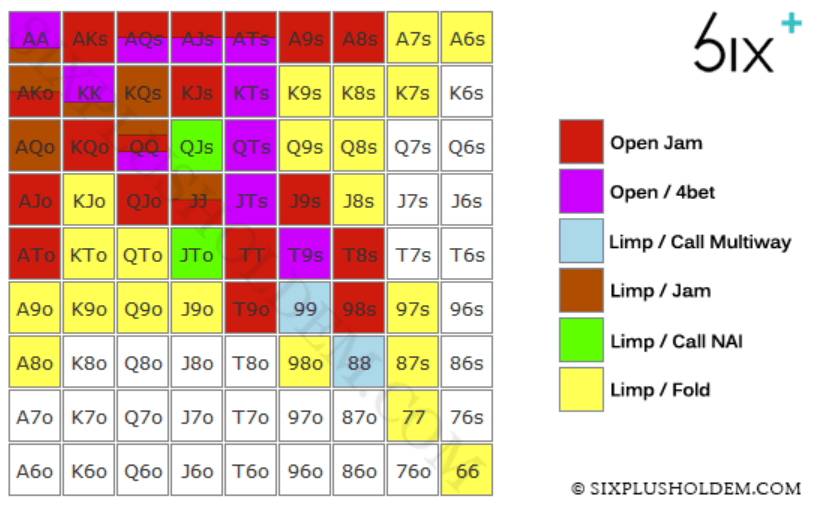
Эти чарты представляют собой набор диапазонов с рекомендациями о том, как следует разыгрывать руки First-in, то есть в ситуациях, когда ни один из игроков не вошел в игру до вас. Он охватывает игру в каждой позиции от UTG до CO, в которой руки прибыльны для Limp / Jam, Limp / Call, Open Jam и т. д.  Данный набор диапазонов предназначен для игры при глубине стека от 50a до 75a. В будущем мы опубликуем чарты для игры со стеком 50а в других ситуациях, но наличие правильного диапазона first-in является основополагающим, так как около 25% рук будут разыгрываться first-in.

Пример:

50a-starting-hand-charts

В этом чарте QJs – Limp / Call NAI  (NAI = Not All-In). Это означает, что мы коллируем рейз нормального размера, но сбрасываем на пуш.

Содержание этой части:

  • 6 страниц ценного стратегического контента (игра по позиции, лимпы, диапазоны пушей с примерами рук и т. д.), а также подробное описание того, как читать чарты и понимать обозначения.
  • Четыре чарта FIRST IN (UTG, MP, HJ, CO)
  • При покупке этого First-in руководства вы получите скидку 20% на следующую часть.

Оплатить покупку и мгновенно скачать файл можно через PayPal. Используйте для оплаты PayPal WalletBitcoin, VISA или Mastercard.

ТАБЛИЦЫ СТАРТОВЫХ РУК Часть 1 (нерейженый банк) со стеками 50 анте

Таблицы стартовых рук,  Часть 1+Часть2+Часть 3

Если вы хотите оплатить покупку с помощью других методов оплаты, свяжитесь с нами по адресу contact@sixplusholdem.com. Мы принимаем платежи на Skrill, Neteller, GGPoker P2P или Crypto.

По любым вопросам, относительно этих чартов рук, или при наличии интереса к более глубокому пониманию игры префлоп и постфлоп, присоединяйтесь к нашей группе discord по изучению игры @Shortdeck Bootcamp

Hand Charts Bundle (Vol.1-4)

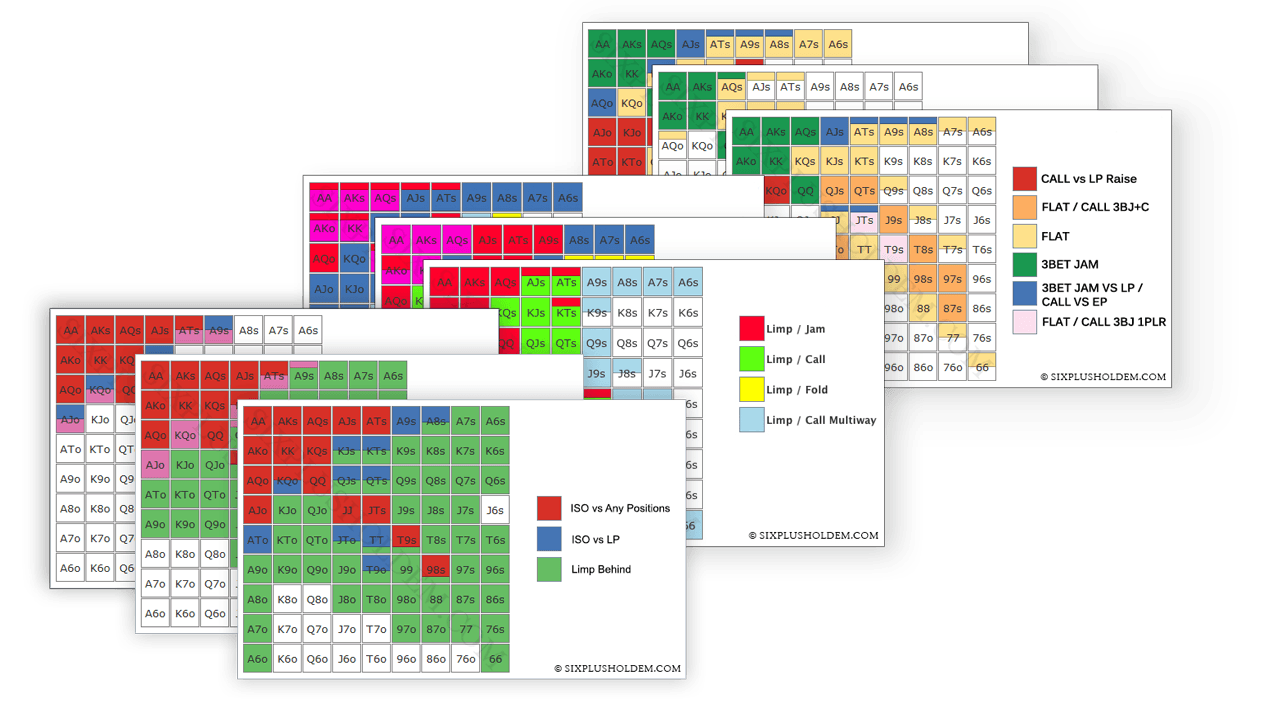
This is the ultimate bundle for 100a-200a play on 5-6handed tables with all four of our published volumes. The volume 1 (first-in), our volume 2 (vs. raise/iso), volume 3 (ISO-raise vs. limps) and volume 4 (multiway all-in).

You can find more info on the charts article of each volume, but let’s quickly summarize what is included in each PDF:

Volume 1

  • First-in ranges for five positions (UTG/UTG+1, MP, HJ, CO)
  • A three page guide with valuable strategy content and chart explanations like (balanced ranges, table dynamics, positional play)

Volume 2

  • Five hand charts for VS OPEN RAISE” (UTG+1 vs OPEN, MP vs OPEN, HJ vs OPEN, CO vs OPEN, BTN vs OPEN)
  • Four hand charts of VS ISO RAISE” (MP vs ISO, HJ vs ISO, CO vs ISO, BTN vs ISO)
  • Four page guide with valuable strategy content and chart explanations like multi-way all-ins, hand playability, hand examples and a thorough walk through on how to read the chart and understand the legend

Volume 3

  • 10 hand charts for “Isolation raising vs. limps (MP vs 2 limpers, HJ vs 1, HJ vs 2, HJ vs. 3, CO vs 1, CO vs 2, CO vs. 3, BTN vs 1, BTN vs 2, BTN vs 3 or more limpers.)
  • Equity table with hand examples on which hands to call when our opponents limp/shove vs your ISO-raise and how we perform with certain hands.
  • 8 pages of valuable strategy content including oRanges calculator analysis with limp-shoving ranges 150a deep and 200a deep examples, chart legend explanations and more

Volume 4

  • Four hand charts for 3-way all-ins” & two villains range per chart (vs standard shoving range, vs wide shoving range, vs tight shoving range of both villain 1 and 2 and vs tight shoving and standard overcalling range)
  • One hand chart of 4-way all-ins” & three villains range (vs standard ranges of all 3 villain)
  • Four page guide with valuable strategy content, chart explanation and hand examples

After purchase you will be able to instantly download a PDF file which includes all charts + strategy. Use either PayPal Wallet, BTC, VISA or Mastercard.

Starting Hand Charts Bundle (Vol. 1 +  2 + 3 + 4)

If you wish to pay with another payment method, please get in touch with us via email at: contact@sixplusholdem.com. We also accept Skrill, Neteller, MuchBetter, GGPoker P2P or Crypto.

For any questions regarding this hand chart or interest in a deeper understanding in preflop and postflop play, feel free to join our discord study group @Shortdeck Bootcamp

50a Volume 1 (First-in)

After offering the 50a SHC only as a promotion for our players on GGPoker, we have now decided to add it to our charts for sale. As many of you might know, the games on the GG Network are played as a 5-handed 50 ante min and 100a max buy-in, so it’s a must-have, if you are playing these games or like to learn the shortstack playing ranges.

Read More