
Isolating Limpers: Part 2

Facing 3-Bet All-Ins

After isolating limpers there’s going to be many times someone will be shoving all-in against you. Preflop equities being as close as they are and the amount of money already in the pot, there simply isn’t much room to 3-bet non-allin.

Calling all-ins really comes down to two parameters. The pot odds and your opponent’s range.

Let’s look at a common example 6-handed 100 antes deep:

UTG limps

Hero raises to 10a in CO

UTG goes all-in for 99

After posting an ante and raising to 10a, Hero needs to call 89a into a pot of 205a, which means you need ~43% equity or more to make a profit.

We won’t go in-depth about estimating the range of hands our opponent could be shoving in this article. If our opponent thinks we are ISO-raising relatively wide, his range could be something like JJ+, AQo+, AJs and JTs. Against this range only QQ+ and AK have 43% equity or more.

If we take the same example, but in this case we were offered pot odds of ~40%, suddenly TT+, AJs+, AQo+, KJs, KTs, QTs, JTs, T9s, 98s are all profitable calls, although some hands only slightly over breakeven. This just shows that in 6+ a small change in pot odds can make a lot of hands profitable calls. That’s why it’s important that you are very aware of the pot odds you are getting and have knowledge of which hands have good enough equity against your opponent’s shoving ranges.     

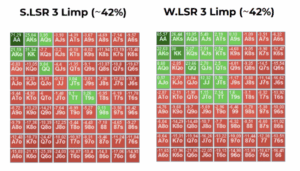
The two equity tables pictured below are from our Starting Hand Charts Vol. 3. You need 42% equity or better to make a profitable call in these two examples.

Standard limp shoving range is defined as:

JJ+, AJs+, JTs, AQo+ (9% of hands)

Weights: <%50: JJ; AJs; JTs> 

We have weighted some hands at only 50%, as we think our opponent doesn’t always shove these hands.

Wide limp shoving range is defined as:

 TT+, ATs+, KQs, JTs, T9s, AQo+ (13% of hands)

The numbers above the hands is the EV of calling all-in in antes. E.g. QQ wins 9.84a on average against a standard limp shoving range when you need at least 42% equity. Against the wide limp shoving range you can see many hands become marginally profitable. Please note we have considered an average rake of 3.5a in these numbers.

This was just a quick example about handling 3-bet all-ins. There’s more content in our Starting Hand Charts Vol. 3 including 8 equity tables (examples above) picturing which hands are profitable to call against standard or wide ranges facing different pot odds and stack sizes.

Ultimate 6+ Chart Bundle (ALL VOLUMES)

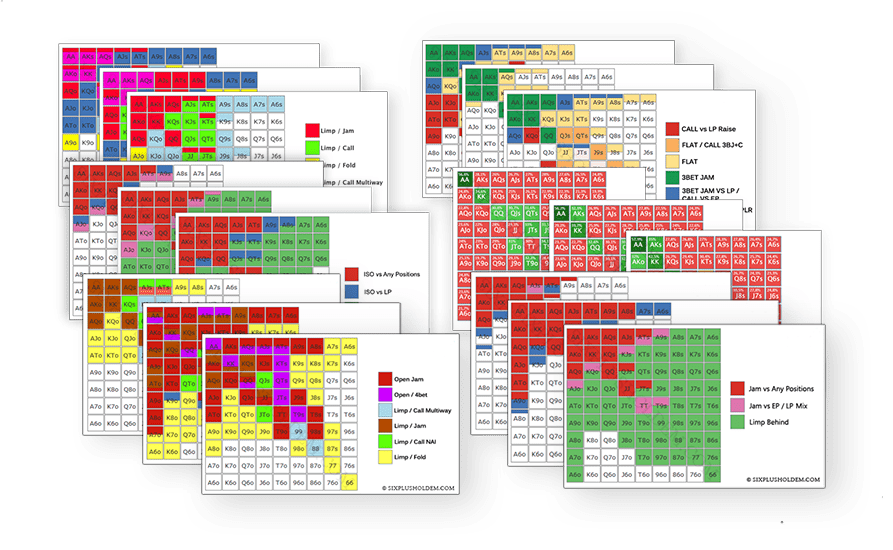
This is the ultimate bundle for 100a-200a play on 5-6 handed tables and 50a-75a play on 5 handed tables with all six of our published volumes. The volume 1 (first-in), our volume 2 (vs. raise/iso), volume 3 (ISO-raise vs. limps) and volume 4 (multiway all-in) & 50a volume 1 (First-In) 50a volume 2 (ISO vs. limps)

It also includes GTO Heads-up charts for 50a and 100a stacksize.

You can find more info on the charts article of each volume, but let’s quickly summarize what is included in each PDF:

Volume 1

  • First-in ranges for five positions (UTG/UTG+1, MP, HJ, CO)
  • A three page guide with valuable strategy content and chart explanations like (balanced ranges, table dynamics, positional play)

Volume 2

  • Five hand charts for VS OPEN RAISE” (UTG+1 vs OPEN, MP vs OPEN, HJ vs OPEN, CO vs OPEN, BTN vs OPEN)
  • Four hand charts of VS ISO RAISE” (MP vs ISO, HJ vs ISO, CO vs ISO, BTN vs ISO)
  • Four page guide with valuable strategy content and chart explanations like multi-way all-ins, hand playability, hand examples and a thorough walk through on how to read the chart and understand the legend

Volume 3

  • 10 hand charts for “Isolation raising vs. limps (MP vs 2 limpers, HJ vs 1, HJ vs 2, HJ vs. 3, CO vs 1, CO vs 2, CO vs. 3, BTN vs 1, BTN vs 2, BTN vs 3 or more limpers.)
  • Equity table with hand examples on which hands to call when our opponents limp/shove vs your ISO-raise and how we perform with certain hands.
  • 8 pages of valuable strategy content including oRanges calculator analysis with limp-shoving ranges 150a deep and 200a deep examples, chart legend explanations and more

Volume 4

  • Four hand charts for 3-way all-ins” & two villains range per chart (vs standard shoving range, vs wide shoving range, vs tight shoving range of both villain 1 and 2 and vs tight shoving and standard overcalling range)
  • One hand chart of 4-way all-ins” & three villains range (vs standard ranges of all 3 villain)
  • Four page guide with valuable strategy content, chart explanation and hand examples

Volume 1 (50 ante)

  • 6 page guide with valuable strategy content (position play, limping, jamming ranges with hand examples, etc) as well as a thorough walk through on how to read the chart and understand the legend
  • Four hand charts “FIRST IN” (UTG, MP, HJ, CO)

Volume 2 (50 ante)

  • 5 page guide with valuable strategy content (Table dynamics, Balanced Range, Positional play and more) as well as a thorough walk through on how to read the chart and understand the legend
  • Nine hand charts “ISO-raise vs limps” (MP vs 1, HJ vs 1, CO vs 1, BU vs 1, HJ vs 2, CO vs 2, BU vs 2, CO vs 3, BU vs 3 limpers)

100a GTO HU volume features:

  • Two page guide on how to use these GTO charts best (charts explained, mixed frequencies and randomization, stacksizes and terminology)
  • Nine hand charts 100a GTO Heads Up (CO OPEN, CO vs ISO, CO vs 3B NAI, CO vs 3B SHOVE, BTN vs LIMP, BTN vs OPEN, BTN vs LIMP SHOVE, BTN vs 4B, BTN vs OPEN SHOVE)

50a GTO HU volume features:

  • Two page guide on how to use these GTO charts best (charts explained, mixed frequencies and randomization, stacksizes and terminology)
  • Eight hand charts 50a GTO Heads Up (CO OPEN, CO vs ISO, CO vs ISO SHOVE, CO vs 3B SHOVE, BTN vs LIMP, BTN vs OPEN, BTN vs LIMP SHOVE, BTN vs OPEN SHOVE)

After purchase you will be able to instantly download a PDF file which includes all charts + strategy. Use either PayPal WalletBTCVISA or Mastercard.

Complete Bundle (SHC and GTO HU All Volumes)

If you wish to pay with another payment method, please get in touch with us via email at: contact@sixplusholdem.com. We also accept Skrill, Neteller, MuchBetter, GGPoker P2P or Crypto.

For any questions regarding this hand chart or interest in a deeper understanding in preflop and postflop play, feel free to join our discord study group @Shortdeck Bootcamp

Isolating Limpers

Unlike regular NLH, where limping is usually the sign of a weak player, in 6+ it’s an integral part of the game. For that reason, there will be many more opportunities to isolate limpers and it’s very common to have two or more players limping, as the odds you are given to limp into the pot are very good, due to the ante structure. You can almost look at limps and ISO-raises corresponding to raises and 3-bets respectively in regular NLH, because it’s so common to limp into pots rather than open-raise.

Position is a very important factor in this game, so one might think that you can very aggressively exploit limpers, by raising a lot of hands to get position throughout the hand. In reality there will be many times, you’ll get reraised or flat-called from players behind. When you do get flat-called that often means that the limper(s) will also come along, so you need decent hand strength to ISO-raise.


What factors are important to determine when we should Isolate limpers?

When deciding to isolate limpers there are many other factors than your hand to consider. Here are four important factors to consider whether you should ISO-raise or not.

  1. Position matters!
  2. Stacksizes – shallow, standard or deep?
  3. Who’s left to act? Passive or aggressive players?
  4. ISO vs reg or rec?


1. Position matters!

Position is something we should always be aware of. UTG & UTG+1 limps are known to be much stronger, as villain should not have a raising range and limp tighter from EP. Therefore you should isolate with a tighter range vs early position limps, and widen up your range against MP and LP limps.

When facing multiple limpers you should pay most attention to the first-in limper. The second and especially the third limper will rarely limp behind with a strong hand to trap. This happens even less so in micro to lowstakes, where the majority doesn’t balance strong hands into their limp-behind range.

2. Stacksizes – shallow, standard or deep?

Just like in every other poker variant, stack sizes play a crucial role in our decision, whether it’s to limp, go all-in or to ISO against limpers.

Shallow stack size is ~60a and below, while standard is anything up to 200a, which would then be considered deep.

If we are facing a fairly shallow stack we should not ISO-raise as light as we might do against another opponent who is 200 antes deep or more. Why? Because if we ISO with e.g. AT, QJ or T9 and get jammed on by a shorter (shallow) stack, we are very often pot committed. This isn’t necessarily always a bad ISO-raise, but it definitely increases the variance in the game. Generally speaking, you should try to play more pots postflop, instead of getting it in with hands that are slightly +EV calls. Playing postflop will have the highest EV on your winrate.

When you are deep stacked you can ISO-raise with a wider range, since villain will face a tough decision if he has a hand that he would normally shove with against ~100 ante stacks. There are not many people that 3bet-bluff OOP, when playing deep, so we will very often be able to realize our equity with the hands we choose to ISO, compared to standard stack sizes where we get shoved on more frequently.

3. Who’s left to act? Passive or aggressive players?

This one is a bit more obvious, but it’s worth mentioning. If you have a very aggressive opponent on your left, you should opt to limp behind more instead of ISO-raising. You would have to fold against many 3bet-shoves and if you are limping with a premium hand, you will have a great scenario lined up for your limp-shove with dead money in the pot, making this a very profitable play in 6+ Hold’em.

4. ISO vs Reg or Rec?

You might wonder why it’s important, but if you are facing a weaker opponent (rec), it is better to ISO with a wide range of hands, because we will significantly profit from the fact that we could be playing heads up and in position against the recreational player. We will make less mistakes, given you already have some experience in 6+ postflop play and are familiar with equities and hand strength. If not, I suggest you check out some of our other beginners content as well as our odds calculator that should help you get a better understanding of the game and how equities run between hands.

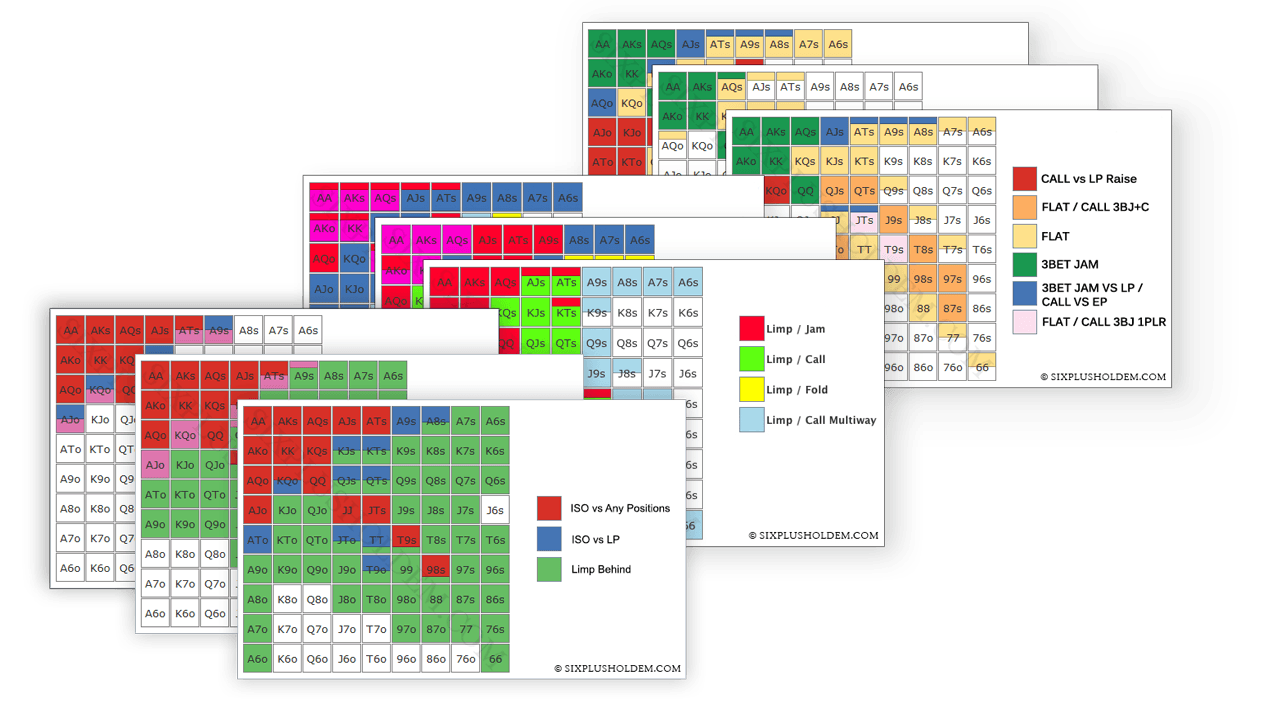
These are the main things you should consider before you decide to ISO over limps. If you would like to become more familiar with solid ISO ranges, we highly recommend you having a look at our Starting Hand Chart Vol. 3, which covers ISO-raising vs. limps, for 100-200a stack sizes.


Summary:

  • Tighten up your range against shallow stacks and opponents that limp / shove a lot
  • Isolate recreational players often with a wider range
  • Be aware who is sitting behind you. Limp more behind on an aggressive table and vice versa
  • Don’t ISO too wide vs EP limps – attack more MP and LP limps


Таблица стартовых рук, часть 4 (Мультивей олл-ин)


В этой части вы найдете очень полезную информацию о стратегии включая чарты 3-ех и 4-ех сторонних олл-инов, которые случаются практически каждую игровую сессию. В данных ситуациях жизненно необходимо понимать свое эквити, какие руки будут прибыльными, а какие будут –ЕВ и должны быть скинуты. Мы посчитали эквити к каждой возможной руке в разных ситуациях, таких как, против стандартного диапазона пуша, против широкого диапазона, против узкого диапазона обоих оппонентов, а также против узкого диапазона пуша и стандартного диапазона колла.


В любом случае Вам нужно будет думать самому и подстраиваться под игру, но чарты помогут Вам усилить свою игру, исправить недочеты и быстро пойти вверх по лимитам.
Чарты содержат оптимальные префлоп решения основанные на тенденциях игроков с учетом базы данных 1 миллиона рук. Чарты созданы для столов с 5-6 игроками с глубиной 100-200 анте.

Пример чарта:
multi-way-all-in-sixplusЧасть 4 включает в себя:

  • Четыре чарта для 3 сторонних олл-инов с диапазонами двух оппонентов к каждой таблице (против стандартного диапазона, против широкого пуш диапазона, против узкого пуш диапазона обоих игроков, против узкого пуш и стандартного диапазона колла)
  • Чарт для 4 сторонних олл-инов с тремя диапазонами оппонентов (против стандартных диапазонов 3 игроков)
  • Четырехстраничный гайд со стратегией, объяснениями чартов и примерами рук.

Купить и получить ссылку на скачивание можно через PayPal, Bitcoin, VISA или Mastercard.

Starting Hand Charts Vol. 4

Starting Hand Charts Bundle (Vol. 1 +  2 + 3 + 4)

Если вы хотите оплатить покупку с помощью других методов оплаты, свяжитесь с нами по адресу contact@sixplusholdem.com. Мы принимаем платежи на Skrill, Neteller, GGPoker P2P или Криптовалюту.

По любым вопросам, относительно этих чартов рук, или при наличии интереса к более глубокому пониманию игры префлоп и постфлоп, присоединяйтесь к нашей группе в Discord по изучению игры @Shortdeck Bootcamp