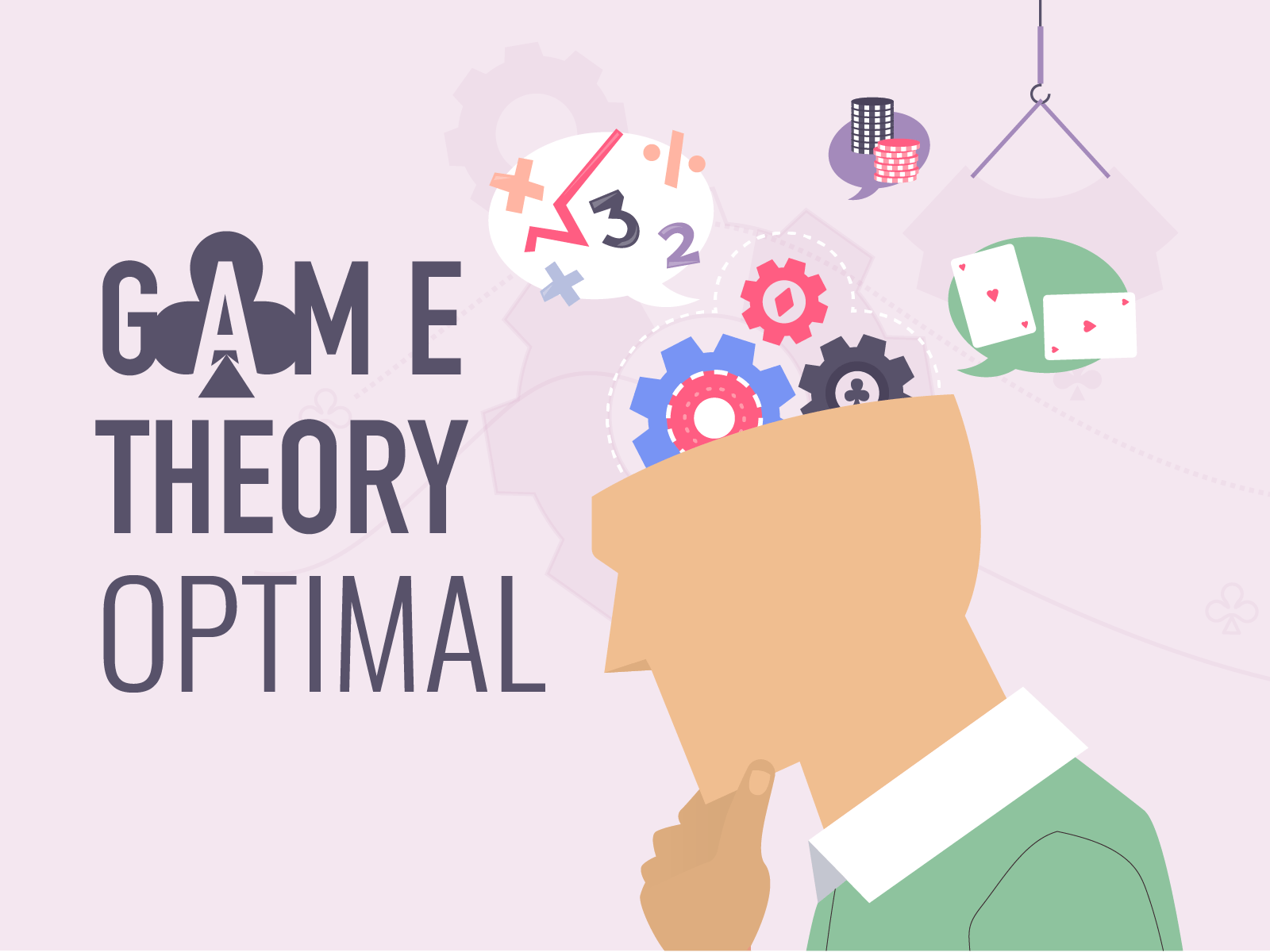
GTO vs exploitative play

 
If you have been around poker for a while, you have heard of the term ‘’GTO’’. It´s actually not a new term. It´s based on the Nash Equilibrium, and was formulated in 1950 by mathematician John Nash. If you are interested in the math and history, there is a great movie about John Nash, called A Beautiful Mind with Russel Crowe. Nash equilibrium can be used to create unexploitable strategies for many different games. 
 
In recent years there´s been more and more advanced software developed, which can create solved GTO solutions for poker, and it has become an integral part of any serious poker player to understand GTO strategy.
 
Game Theory Optimal, in poker, is an umbrella term players use to describe the holy grail of no-limit holdem playing strategy, by which you become unexploited to your opponents and improve your winrate. It essentially solves the game. No longer do you have to think what to do, when you are in a limped pot vs button and flop comes AK6r. GTO tells you to bet, so you bet. It even tells you the exact sizing to use. Apply this to all spots and now you don’t even have to think. All the spots are solved like Tic Tac Toe.
 
As a player who studies with solvers and runs a GTO study group, I can confirm that studying GTO is important, but it is at the same time misunderstood and overrated. In this article I will try to explain how to study and apply GTO.
 

There are two main problems with GTO

  1. You can’t really learn it and apply to all situations, since the combinations, pot sizes, number of people is way too much. The human mind can memorize all the correct moves in Tic Tac Toe but cannot possibly learn even 10% of all GTO spots in 6+.
  2. GTO means a balanced, unexploitable play. It’s not the most profitable strategy. You can’t win versus GTO. But if you are playing at a 6-max table with four fish and one GTO bot, you will have a higher win rate vs fish, if you play exploitative.
 
Let me give an easy example. You have a player 100a deep open shoving every single hand. GTO doesn’t know that this guy is drunk and open shoves everything, so GTO charts tell us to call AQo and JJ+. But since you, as a player know his range is any two cards, you can easily call KTo and it’s a very profitable call, while GTO would consider calling KTo a huge mistake.
This is an easy example, but let me give you a slightly more complicated one. Say you are playing 6-max, everyone is 100a deep. everyone folds to HJ, he limps and CO limps and you are on the button. This is what we are supposed to do preflop.
 

GTO Charts (click here to read more about the GTO charts):

As you can see, we are never raising NON all-in with QJs, KQs. We jam KT, QTs and JTs. That is because, GTO doesn’t want to ISO and then fold to an all-in with playable hands like QJs. And GTO as HJ and CO has plenty of limp/shoves. This is what HJ is jamming vs CO limp and BTN 9x ISO (in red, picture below).
 
In real life, random players don’t jam near that much. Probably only AQo and better. So the correct play here is an exploitative one, non-allin ISO your suited KQ and play a pot with a good hand in position.
 
So naturally, the correct strategy is to mix GTO and exploitative strategy. This of course you knew already, so what is the point of writing all this stuff just to get to an obvious answer. Everyone knows the best strategy is mixed and adjusted. But here we will try to understand, in which spots you should go exploitative and in which spots you should stick with GTO, despite playing versus fish.
 

Improve your win rate with GTO

 
Let’s say you want to achieve the highest evBB possible in 6+. If you only want a nicer looking graph, there are a few small ‘’cheats’’ you can do, such as only learning one strategy (50a 6-max) and only playing that, and leaving the table as soon as it’s 5-max or as soon as you have 60+ ante. This way your bbEV will be high, but this is not the best strategy for making money, because you shouldn’t leave the table if your bbEV drops from 40 to 30, since 30bbEV is still better than your 0 winrate you have if you stop playing. So, for this scenario, let’s see how to achieve the highest bbEV on any table you decide to play.
 
Number one is, you should learn as much GTO as possible, for every spot, on all boards. But you shouldn’t follow it blindly. After learning GTO, when you are in a spot and thinking ‘’should I bet or check here’’, you should remember what GTO does. But then you should think further ‘’ok, GTO bets here, I remember. But why?’’. Then you have to remember the reasoning for the GTO play.
 
For instance, on a board of T96, turn 6, UTG vs BTN, GTO usually doesn’t double barrel as UTG when called by BTN. That is because BTN calls all 6x on the flop, and BTN has all 6x hands, while UTG doesn’t have almost any 6. So this 6 on the turn helps BTNs range. So in this spot you should remember that GTO checks, because that 6 helps BTN more.
 
Then the last step is to think ‘’Ok, I know what GTO does and why. Does this apply to this current hand?’’. So let’s say in this T966 turn scenario we have KQ, and we know that GTO tells us to check (I haven’t actually run this scenario in GTO, just using this to illustrate an example). We should analyze our opponent. Is he a regular who has studied GTO a lot and pretty much plays as he should? Then check, sure. But let’s say we are playing a nitty player that we know well. We know that he would fold J6, Q6, K6 and A6 on the flop because he doesn’t consider those hands good. And he will fold his draws (J8, etc.) on the turn, because he doesn’t want to chase draws on a paired board. Versus this player, we should realize that GTO analysis doesn’t really apply, because he doesn’t play close to GTO. That’s why checking KQ here and saying ‘’it’s literally GTO bro’’ is bad. We are losing a lot of EV when we decide not to double barrel vs this player.
 
So in each hand, you should go over these steps
 
  1. What does GTO do here?
  2. Why?
  3. Does this apply here?
 
There is a reason why regulars have 30-40a winrates vs fish, while GTO has 20aEV vs fish. It is because we are able to pick up more information than GTO – is this player ever capable of bluffing?, is he angry?, is he drunk?, timing tells etc.. Information that computers don’t know. The best regs know when to use all weapons.


Mindset is everything

In poker, there’s so much falling under the “mindset” umbrella.

  • Emotional management
  • Reframing / Perspective management
  • Focus
  • Motivation
  • Structure
  • Productivity
  • Goal management

… and so much more.

Take a good look at your poker mindset right now, and answer this question:

How well are you managing your poker mindset from 1-10?

When you are a winning poker player, you have to be professional.

You have to treat your mindset like a professional.


Where to start?

The good news is that there’s a very specific place for you to start to improve your poker mindset.

Working on this one thing is going to influence everything under that “Mindset Umbrella”.


And it is…


Drumroll…


Your thoughts.

Let me tell you a quick story.

I worked with a highly skilled coach for a period.

95 % of the time we solved my thoughts.

We uncovered limitations in my thinking. 

We found the holes that were creating negative results.

We explored new thoughts.I practiced thinking new thoughts on purpose.

That’s it peeps.

Behavior is a by-product of thoughts + feelings.

So when you commit to higher quality thoughts, you create higher quality feelings and then higher quality behavior follows.

So all of that…

  • Tilt
  • Lack of motivation
  • Feeling blue after a losing session
  • Being unfocused and distracted
  • Procrastination

… decreases all of a sudden.

Now don’t get me wrong. These elements will probably always be in your life to some extent. 

But when you learn how to manage your thoughts you create the ability to change everything in your life to the better.


One of the best exercises to start managing your thoughts

I learned this exercise from another coach. It’s called a thought download.

It’s really simple…

But really powerful.


Thought Download (do this for seven days in a row):

  1. Grab a piece of paper and leave it on your desk next to your keyboard
  2. After/during each session I want you to write down all the negative thoughts that appear in your mind. For instance:
  • Why am I so unlucky all the time?
  • I just can’t win a hand!
  • That guy is so lucky…
  1. After seven days you go through your negative thoughts. Identify the most limiting ones.
  2. Create two empowering reframes for each limiting thought you identified.
  3. Keep your reframes in front of you in each session. Practice thinking about them on demand.
  4. After a while your empowering reframes will be your new default and voila, massive sustainable change is achieved.

That’s it.

This is where you start to improve your poker mindset.

Doing this work is really simple. It doesn’t take a lot of time and energy. 

And it has the potential to change your life completely.

If you want feedback on your thought download, you can join the SixPlus Discord Community and write to me. I am happy to help!


Bonus exercise to help you getting started with your poker mindset

As per this date there’s a meditation challenge running in the SixPlus Discord channel. 

We motivate and help each other to meditate every day.  The challenge runs until April 1 2022. 

But new challenges will emerge after this one. So head into the SixPlus Discord Community and find the meditation challenge thread. Hope to see you there!

The Two Shockingly Easy Secrets to Stop Tilting in Poker

“Peter, I never tilt, it’s not a problem.”

If you say you never tilt, you’re probably lying (or very unaware).

Yes, I said that. Calling you a liar.

Tilt isn’t just “raging, shouting and beating your fist into the wall” after a bad beat.

Tilt is when you get affected by emotions and play worse than before.

Sure, frustration and anger are the usual suspects when we tilt.

But what about feeling bored? Feeling injustice? Feeling bullied? Feeling sad? Feeling lonely?

There’s a variety of feelings that can impact your winrate (often without you knowing it).

If you read this article, I’m sure that you will experience less tilt in the future and be able to win more money consistently.

Your tilt won’t disappear magically, but I can help you become aware about what tilt you experience and help you take control over your mind to reduce it.

How most players try to deal with tilt

“I normally try to realize when I tilt and tell myself to stop it”.

These are the words of one of my clients.

He’s a good NL200-500 reg and has a strong mindset.

But every time he tried to tell himself “do not tilt” it didn’t work.

Why?

Because it does not treat the root cause and it doesn’t offer him a better perspective.

And that leads me to the two most effective ways to stop tilt in poker.

Strategy #1: Create a tilt profile

It sounds boring to create a tilt profile. I get it.

And what is it anyway?

Well, a tilt profile is all about understanding your tilt and where it comes from.

“Peter, I know my tilt. I just get fucking angry and start playing bad”.

That’s not good enough.

I want you to expand your awareness. I want you to know why your tilt comes and the deeper roots behind it.

To make your tilt profile answer these questions now:

  • What are the trigger/s that make me tilt?
  • What emotions do I feel?
  • What situations in my life may be adding to the limiting state of this feeling?

Here’s an example:

  1. Triggers: Playing vs the aggressive reg who seemed to own me
  2. Emotions: I felt bullied. I felt weak. I felt like I was a bad player.
  3. Bigger picture: I guess this could have something to do with me being bullied in school. I experienced XYZ … and I now understand how experiencing something ‘similar’ on the poker table creates such an intense feeling in me.

Now these are golden nuggets. This is awareness on a new level.

Awareness is essential to start treating the root cause and not just put band aid on the symptoms.

Strategy #2: Choose your perspective

What creates tilt?

Your perspective.

Nothing else.

It’s not you being unlucky. It’s not you losing money.

It’s how you put your perspective on being unlucky or losing money.

Get it?

Let me give you an example.

What perspective do you think creates the most tilt?

“That guy is so fucking lucky all the time against me”

or

“Okay, he got lucky there. But if I keep playing my A-game I will eventually win over this guy. These situations are what allows me to make a living out of the game.”

The perspectives are on the exact same situation. You got unlucky, and villain won the pot.

It’s so important to realize that you can choose a perspective that helps you feel better.

It seems so simple, right?

But we often lose control over our thoughts in the heat of the moment.

That’s when we go down the rabbit hole of creating limiting thoughts.

Thoughts that lead to tilt.

Right now I want you to:

  1. Identify three thoughts that often occurs when you are tilting
  2. Write three reframes that helps you feel better

Ready, set, go.

Don’t skip it!

I get it. Reading about the work is much easier than doing it.

So now, I want you to make a conscious decision.

Decide to do the two steps now.

Don’t think about it. Grab a piece of paper or open Google Docs and write.

It has the potential to make your winrate explode and help you in more areas of life than poker.

I know that doing mindset work on your own can be tough!

Do you want help with emotional management, mindset and effective ways to deal with tilt (and much more)?

Reach out to me. You can learn more about me and my coaching at www.pokerlifecoach.com

I only have a couple spots left for clients, so no promises.

Join one of the best free communities for poker mindset work

Join the SixPlusHoldem Discord server today to learn more about the mental game of poker. We have a mindset channel where we discuss tilt, meditation, and other mindset strategies for being a better poker player. Take your game to the next level today.

See you there.

Your Mindset Coach
Peter Rasmussen
GTO play on A-A-7 (free multiway solve)

Here’s a look at how GTO (Game Theory Optimal) approaches this scenario on a board of A-A-7 rainbow. It was solved with our private multiway solver by our GTO coaches and we are happy to share this free solve with you. It was created for the students of the study group and if you like to learn a more GTO based playing style for 6+, you may check out our GTO Multi-way Solves Videos

So let’s jump right into the action. We are looking at a 5 way spot, 50Antes UTG vs MP vs BTN (CO & HJ folded pre).

First thing, we can notice is that UTG on this board bets quite a bit (65.5%) and the reason for that is because here UTG actually has a range advantage.

We can see that UTG has more pure Ax hands in its range as MP already starts to jam most of them preflop.

Second thing is that solver wants to use solely 33% sizing and the reason for that is, because UTG’s range hits so well on this board that it basically can go range betting almost whole range (Solver is not because then bluff frequency will be too high and MP’s response for that will be to start x/raising tons of hands but in real-games we can range-bet 80%+ of our range, in particular, with 2 backdoor hands where we can barrel a lot on turns until people figure it out and adjust.

In real games people won’t be defending enough, in particular, hands like KQ, KJo, KTo and maybe even not pocket pairs like 66, 88, 99. For what it’s worth we definitely should call against this sizing all pocket pairs even against biggest nits who we know always has Ax there because of pure pot odds.

It’s true that in real-games people might not be jamming preflop as wide also, so argument could be made that MP will still have tons of Ax hands in its range but then in-game we can check MP’s VPIP frequencies and chances are that MP is overlimping as well, hands like Q9, K9, J9, J8s, Q8s etc. Also, even against more Ax saturated range 33% bet from UTG is very profitable bet and doesn’t need to go through so often to make it a profitable play.

This is BTN’s calling range and I think it’s very close to what people would call in real games – Ax, pocket pairs and flushdraws.

If we take a look at MP’s and BTN’s raising ranges then for both they are very similar – always 77 and then for MP its 98ss, 97ss and for BTN A7 and then Solver adds some bluff-raises with blockers for balance.

In real-games I don’t think we have to balance this as people wont be able to make a note of this and if we hold 77 and there are bets in front of us, there is no way that people will fold Ax here after we raise.

To make it more interesting – both players (MP & BTN) calls UTG’s flop bet and we go to turn. There is a pattern on two different turn classes: on high card turns without spade (A, Q, K,) UTG continues barreling on turn because it has nut advantage on these high card turns and also very likely that UTG’s AQ and AJ are still good.

Whereas on low card or/and spade turns UTG now checks its range because it was betting flop pretty wide and once called by 2 players it wants to slow down as on turn it has wider range versus 2 narrower calling ranges where it doesn’t have nut advantage.

now versus bets UTG just pretty much calls some flushdraws (mostly combo draws) and Ax hands.

On high card turn its a bit more interesting though, this is what UTG continues barreling with, important note with bluffs like QTo, JQo, JTo is that we want to do this without a spade so there is a bigger chance that villain has a flushdraw instead of Ax hands.

This is UTG’s jamming range on river.

On river UTG bluff catches with weaker Ax, in particular, with ones not holding a spade and jams for value better Ax hands such as AJ and AQ. Bluffs mostly with 66 as it unblocks MP’s folding range as MP doesn’t have any FDs missed having a 6 in them (K6s, Q6s etc folds preflop).

Exploitatively I like going really small on the river with bluffs (like 12Ante) just to fold out missed flush draws but of course its not solver approved play, because if we do not merge our sizings we open ourselves up for being exploited.

Interesting and cool thing about UTG’s range advantage is that if UTG decides to check OTF and MP bets then UTG goes for raise 41.2%

Then if it gets called by MP it proceeds with very similar strategy and pattern as we discussed previously – barrels more on high, non-spade turn cards and checks a lot on spade and/or low turn cards.

Happy if you made it this far! 🙂 This was, as mentioned, a free multiway solve (either text + images or in form of a video) from the GTO study group and if you like to learn more, feel free join our Discord channel if you have a question regarding GTO or anything  6+ related.

Thanks for tuning in and good luck on the tables. 🍀

Beginners Video Bundle

We have created this bundle to help you get started with the most important topics to begin with as a beginner for a very fair price. 

In total you will get around 11½ hours of strategy content, split into 5 different topics: (for a more detailed description of each part, please click on the links below)

  1. Preflop: Road to 6+ Winning Player (total around 2hours) $39
    1. Part 1: Limping (30-40min)
    2. Part 2: Open raising/ Isolating (30-40min)
    3. Part 3: Facing a raise / 3-betting (30-40min)
  2. Postflop: Road to 6+ Winning Player Course (total around 2½ hours) $59
  3. NL100 Session Review on GGPoker (3 Part Series – total of 3.5 hours) $29
  4. Playing ISO Pots (1 hour video) $19
  5. Playing Out of Position (1 hour video) $19

Total Price of all videos: $165

All videos will be available for streaming after purchase.

With Bundle Discount: $99. Save $65!

Beginners Video Bundle

If you wish to pay with another payment method, please get in touch with us via email at: contact@sixplusholdem.com. We also accept Skrill, Neteller, MuchBetter, GGPoker P2P or Crypto.

For any questions regarding these videos or interest in a deeper understanding in preflop and postflop play, feel free to join our discord study group @Shortdeck Bootcamp