All posts by contact@sixplusholdem.com

Beginners Video Bundle

We have created this bundle to help you get started with the most important topics to begin with as a beginner for a very fair price. 

In total you will get around 11½ hours of strategy content, split into 5 different topics: (for a more detailed description of each part, please click on the links below)

  1. Preflop: Road to 6+ Winning Player (total around 2hours) $39
    1. Part 1: Limping (30-40min)
    2. Part 2: Open raising/ Isolating (30-40min)
    3. Part 3: Facing a raise / 3-betting (30-40min)
  2. Postflop: Road to 6+ Winning Player Course (total around 2½ hours) $59
  3. NL100 Session Review on GGPoker (3 Part Series – total of 3.5 hours) $29
  4. Playing ISO Pots (1 hour video) $19
  5. Playing Out of Position (1 hour video) $19

Total Price of all videos: $165

All videos will be available for streaming after purchase.

With Bundle Discount: $99. Save $65!

Beginners Video Bundle

If you wish to pay with another payment method, please get in touch with us via email at: contact@sixplusholdem.com. We also accept Skrill, Neteller, MuchBetter, GGPoker P2P or Crypto.

For any questions regarding these videos or interest in a deeper understanding in preflop and postflop play, feel free to join our discord study group @Shortdeck Bootcamp

Playing Out of Position

In this video Coach Karlis explains the most important aspects when playing out of position in 6+, which is very different compared to NLHE with many other factors that we need to consider. We will break it down in ISO and Single Raised Pots, including many hand examples so you will feel much more confident in playing OOP and maximize your winrate, because these scenarios happen very often and it’s crucial that you know how to approach these spots.

This video is primarily focused on analysis of post flop play. If you are a beginner you will get the most out of this video if you already have some understanding of preflop raising and isolating ranges.

Topics covered in this video:

  • When to raise preflop (w/ hand examples)
  • Playing raised flops postflop (w/ hand examples and equity calculation)
  • Preflop ISO calling ranges
  • Postflop play in ISO pots (w/ hand examples and equity calculation)

The video is 1h long and you will be able to stream it in our library under  ➜ my videos after purchase

ISO & Raised Pots OOP

If you wish to pay with another payment method, please get in touch with us via email at: contact@sixplusholdem.com. We also accept Skrill, Neteller, MuchBetter, GGPoker P2P or Crypto.

For any questions regarding this video or interest in a deeper understanding in preflop and postflop play, feel free to join our discord study group @Shortdeck Bootcamp

Playing ISO Pots

In this video our Coach Karlis breaks down the key fundamentals on playing ISO pots, both in and out of position. It’s 1 hour long and features different topics that are important, when we decide to isolate limpers and more importantly how we approach the situations on different flops and runouts.

Knowing how and when to ISO is one of the most important aspects in the game of 6+, so improving on this is mandatory if you want to get a good winrate.

We have picked plenty of hand examples including equity calculations to make it easier for you to understand how we should approach different scenarios with different hands. This video will be helpful for beginners but also experienced players alike, as we dig a little deeper into the spots.

Topics covered in this video:

  • When to isolate non-allin?
  • Hand selection for NONai ISO’s
  • Hitting the flop as the preflop aggressor (with hand examples)
  • Missing the flop as the aggressor (with hand examples)
  • Range example with calculations in Oranges
  • Going through the thought process OTF in ISO pots
  • Difference between playing regulars vs recreational players
  • Equity calculations on different board textures

Unlock this video in our library for a price of $19. After purchase, you can stream the video in your library under ➜ my videos.

Playing ISO Pots

If you wish to pay with another payment method, please get in touch with us via email at: contact@sixplusholdem.com. We also accept Skrill, Neteller, MuchBetter, GGPoker P2P or Crypto.

For any questions regarding this video or interest in a deeper understanding in preflop and postflop play, feel free to join our discord study group @Shortdeck Bootcamp

Note taking when playing without a HUD

One of the best sites to play 6+ / Short Deck is GG poker. There is plenty of action and rakeback is good, compared to the nearly zero percent PokerStars offers you. The one disadvantage is that you can’t use a HUD when playing, so you are missing a lot of information, especially if you are playing 3+ tables. So note taking and using player tags is extremely important if you want to have a great win-rate.

A lot of regs just tag someone a fish because they made a non-GTO play, which is dangerous, because there are many categories of recreational players, and tagging someone a ‘’fish’’ will not tell you how to take advantage of his lack of 6+ knowledge. Note taking is a skill in itself, so I will show you how to make good notes and how to classify players.

If I had to choose the most important thing taking notes about, it would be preflop raising: from which positions do people raise preflop and what sizing do they choose.

Example:

5-handed, everyone has 100A. UTG folds and UTG+1 makes it 8x preflop. It goes to showdown and he flips over KK.

In this situation I would make a note which would look like this:

‘’utg1 8x KK 100a 5h’’

That means raised under the gun 8x with KK 5handed while 100a deep.

It just allows us to read the note quicker, while we have to make decisions on other tables.

Why is this so important?

Just this one hand tells us that:

1) This player is probably unbalanced when it comes to his preflop range. He is probably raising good hands and limping bad hands, which means he is probably not a regular.

2) Since he is raising big with good hands, his limps are much weaker so we can attack them.

3) We can easily put him on a range when he raises and play hands that can crack QQ+ (98s, T9s etc), while folding hands preflop that do badly against a strong preflop range (QJo, KQo, AJo etc)

Let say one orbit later the same player is on UTG+1 again and now opens 3x from UTG+1 again with you on the BTN. Everyone calls his preflop raise. What would you do in this situation with ATs? AJo? KQs A9s? Fold since he is raising again?

The answer is no. You can go allin with all of these hands. Because we know that his standard opening sizing was 8x with KK, 3x is almost always going to be a weaker hand and since everyone else just called, there is about 20 antes of dead money in the middle. The 3x raiser will almost always fold and so will everyone behind them. The chance that CO called that 3x raise with a strong hand like AK is pretty much 0%, so we can pick up 20 antes for free.

Of course, we are generalizing. It’s possible he just opens random sizings and might raise 8x with KK in one hand and 3x on the next one. It’s still a profitable play, since we will be right most of the time, and in case we were wrong and he flips over KK, our A9s still has 44%. That’s the good thing about being agressive in 6+, you always have a decent equity if you get caught preflop.

All of this was possible, because we paid attention and made a note about a player’s sizings.

The second most importand thing to figure out is a recreational player’s VPIP. It’s very easy to play against someone who has a 75% vpip, you just have to notice when someone plays too many hands.

Say you are in the hand. Villain limps UTG. Three other players limp also. Nothing happens till the river, everyone shows their hand and that’s the end of this small pot, but you notice that villain limped J7o from UTG. This is very far from a normal UTG limping range, so I will make a note

‘’L utg 100a J7o 5h’’

That means ‘’Limped J7 offsuit under the gun five handed 100 antes deep’’.

Okay, so he limps a little too loose, how can we take advantage of that?

Example:

Villain limps UTG. Everyone folds. Regular on the CO limps as well and we are on the BTN with QJo. Normally this would be an easy check, since we want to play this hand in position and we don’t want anyone to limp / shove, especially since we are playing against an UTG range, which is the tightest. But because we know UTG limps too wide, we can ISO-raise very wide in this spot. We are not risking getting limp / shoved from UTG and from CO (since regs don’t trap on CO). QJo becomes a great ISO-raise hand in this case. Either we get two folds and we pick up 7 antes for free,, or someone calls our ISO-raise and we are in position with a very playable hand and range advantage.

These are two examples where we can win pots just by paying attention, finding a weakness and taking advantage of that. In both examples, this aggression will work because other regulars will overfold when you are showing strength by reraising allin and in the other example, attacking an UTG limp, since you are showing aggression against a strong range, people will think you are strong too. The truth is you just paid more attention and saw that villain was weak due to note taking.

Article by „coixdog“. If u want more tips on note taking or other topics, you can book coaching lessons  with our coach coixdog on Discord or contact us at contact@sixplusholdem.com

GGPoker Short Deck Series 2021

GGPoker has in recent times had success hosting big tournament series like the Online WSOP or Omaholics Series. They even have a weekly series called MILLION$ with five million dollars in total guaranteed price pool. Now the time has finally come for a 6+ / Short Deck series, which will feature a total guaranteed price pool of one million dollars. It’s not large compared to many other series, but at least they finally host one.

The Short Deck series will run eight days from Saturday 4th of July to Saturday 11th of July. For any experienced player there should be a lot of value in this series, and to help people plan their schedule we will present an overview of the series and it’s structure here with focus on the Main and Mini Main event. You can find a complete overview of the tournament series at the bottom of this article.

Main and Mini Main Event

$525 Unlimited Re-entry Bounty Main Event $100k GTD

$52.50 Unlimited Re-entry Bounty Mini Main $50k GTD

These will be played with a Stage 1 and a Final Stage, where the final will be played on July 11 at 21:30 CET. Each day will have two Stage 1 tournaments starting at 15:30 CET for the early heat and 21:30 for the late heat.

Play in Stage 1 ends at level 14 (total playing time of close to 4 hours) and it’s important to note that if you qualify in multiple Stage 1 tournaments your bounties and stacks will be combined for the Final Stage. You could potentially play all 15 Stage 1 tournaments and acquire a massive stack and bounty.

Since these are all bounty tournaments it’s not recommended to register late if you can avoid it. It’s important to give yourself the best chance at acquiring a large stack in bounty tournaments.

Side Events and Multiple Stacks

Each day will offer smaller Short Deck tournaments, where most have 2- or 3 Stack formats, which might be unfamiliar to many. If a tournament is a 3-Stack format it means that you would have 3x 10.000 chips at your disposal. It’s up to you if you want to take 10.000, 20.000 or 30.000 to the table, which can be done any time until registration ends. Of course you can take 10.000 at a time and you’ll have two more chances if you bust. Our recommendation would be to always try to cover weaker players at your table. It’s also unlimited re-entry, so if you plan to re-entry always try to cover weaker players.

Most side-events will offer Early Bird Bubble Protection, so if you register before the tournament starts you’ll have the added benefit of bubble protection.

Final Day: 11th of July

Featuring $10,300 Super High Roller $200k GTD

Mark this day in your calendar, if you are a fan of the big buy-in Tournaments. On July 11th, not only the two mains (mini and main) will take place, but also a $10,300 Super High Roller with a guaranteed prize pool of $200K USD will run at 09:10 PM CET. Check in a day or two early to possibly find some satellites for it, but as of now, there are none available.

We wish all participants the best of luck and hope you will have plenty of deep runs. 🍀

New to GG Poker?

GGPOKER SIGN-UP OFFER FOR NEW PLAYERS

If you sign-up on GG, using our bonus code (contact us for the code), you will get 10% from your total net rake back, in form of store credits. This means you can use those to purchase anything we offer on our homepage (HUD sub, Charts, Courses, etc.).

Example: You rake a total of $800 in March, you can choose any product from our homepage for $80 or less, and use the remaining for other items. Alternatively, it could also be deducted from an item that costs more, so you would have a $80 discount on it.

In addition to this, you will also get exclusive MTT tickets from invitational events and similar, which are only valid if you used our bonus code in the sign-up form.


Full Tournament Schedule

Terms & Conditions

  • Players must be aged 18 and above to participate in this series.
  • Please note that tournament prize pool guarantees are subject to change and some amounts listed on this website may not be current; please check the guarantee amounts listed in the tournament lobby of the GGPoker app for up-to-date prize pool information.
  • The promotion terms and conditions are subject to the site terms and conditions, which can be found here.
  • GGPoker standard rules apply.

MuchBetter Wallet Review

MuchBetter has since it’s launch in 2017 quickly emerged as a valid alternative to other payment processors and wallets like Skrill and Neteller. The company is based in the UK and regulated by the FCA (Financial Conduct Authority), also based in the UK.

The main benefits of MuchBetter are their low fees and the ease of use. They are supported by many online gambling and poker sites, including major poker sites like PokerStars, PartyPoker and GGPoker.

The only major country not supported by MuchBetter is the United States.

How to Register on MuchBetter

It only takes minutes to register. All you need to do is open our sign-up link here, and then enter your personal details. As the final steps you will need to install the MuchBetter app on your phone. The app is your main interface for everything you use MuchBetter for. E.g. if you wanted to deposit to a poker site you would simply put in your phone number registered with MuchBetter into the poker sites cashier and then you can confirm the deposit in the app.

Deposits and Withdrawals

The options for funding your account depends on which country you reside in and there are too many to present them all here. A normal bank or SEPA transfer has no fees, whereas VISA or Mastercard can have 0 to 5% fee, depending on your region. You can also deposit with Bitcoin at only a 2% fee.

For withdrawals popular methods like SEPA bank transfer there is a 2% fee, but they also provide withdrawals via Bitcoin at 2%. Regular bank transfers will however cost 0 – 5% depending on which country you reside in.

If you are interested in a complete overview on methods and fees please click here.

Using your MuchBetter Account

The really amazing benefit for using MuchBetter is that, once you have funded your account, it’s free if you want to transfer or receive money from a friend or deposit / withdraw money to a poker site. If you have ever sent money to a friend using other payment processors you likely would have been disappointed with how costly this can be in fees. With MuchBetter you won’t have to worry about such things. The only fee there is would be converting currency, which comes at 0.99%.

Moneymaker Poker Promotion

During last September MuchBetter offered a special poker promotion with the chance to win entry to a major tournament with $10.000 buy-in or other prices like one on one training session with Chris Moneymaker. A great promotion for all Poker fans and we can expect more of such kind in the near future. Stay tuned for more.


MuchBetter Prepaid Debit Mastercard ® and Fob

If you reside in an EEA country you can order a free MuchBetter Debit MasterCard to spend your funds. They also offer a special key-chain fob for contactless payments, which makes spending funds super easy in stores and shops.
Using your card or fob costs absolutely nothing in fees, except ATM withdrawals which cost 0.99%.

Conclusion

With some of the lowest fees on the market and ease of use, plus wide range of deposit and withdrawal methods, MuchBetter beats a lot of the competition. If you wish to give MuchBetter a try please sign up using this link.


Flopping Two Pair in 6+ Hold’em

When you flop two pair in no limit hold’em, usually the biggest problem you will face is how to get the most chips in the middle. Unfortunately in 6+, not only is your opponent more likely to flop sets and straights against you, but with equities running much closer, even if you have the best hand, your opponent will have more outs to catch on turns and rivers. 

Let’s have a more in-depth look at some spots, that occur frequently:

Scenario 1: 6-handed, everyone has 100a 

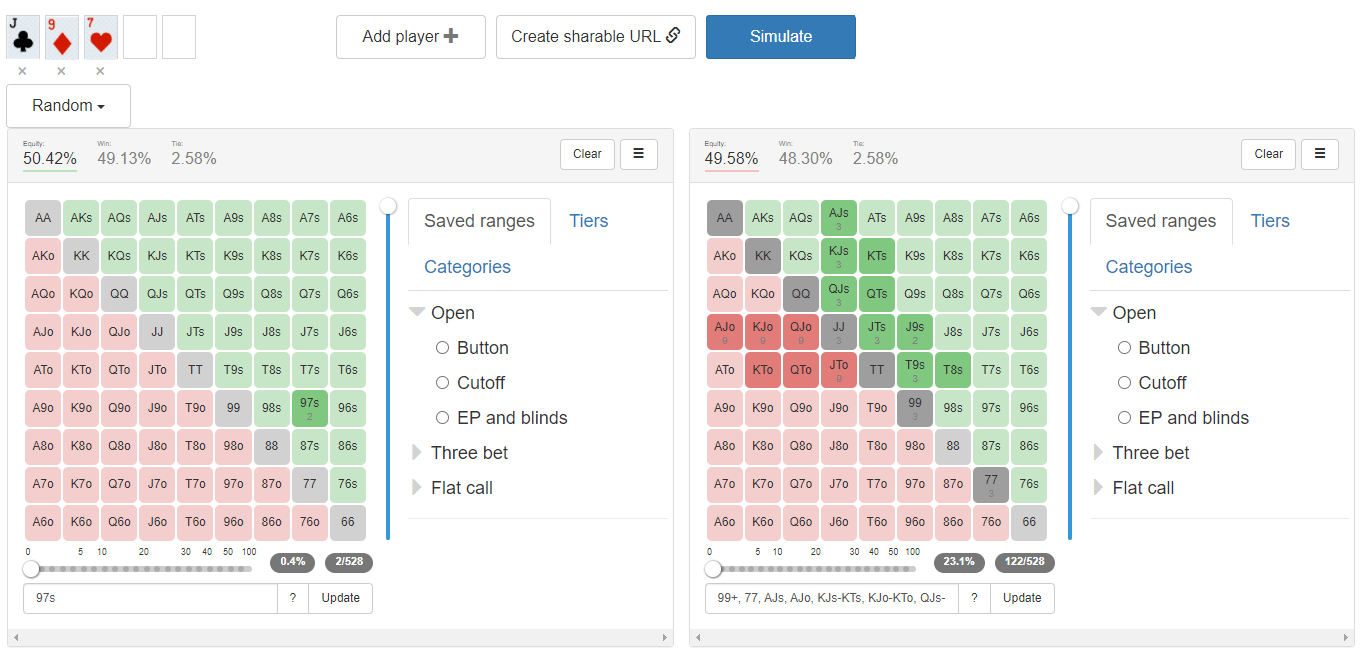
Hand 97 

UTG fold, UTG+1 folds, MP limps, Hero limps HJ, CO limps, BTN checks, 4 people to the flop 

Flop : J97 

MP bets half pot, Hero ? 

We got two pair on a rainbow flop and the MPs sizing isn’t too big. Someone who just switched from no limit hold’em to 6+ might be happy to call here or even raise before we see any scary turns like 8,10, Q etc.

The truth is, especially with two players behind us left to act, it’s an easy fold. Not only is MP showing strength by leading into three opponents, but since CO and BTN were in late position, they can have almost any two cards when they limp in, so they have all the straights and better two pair combinations. If Hero was on the BTN and everyone folds to us we should be calling (especially since MP usually won’t have T8o), but even against his range with all T8o removed, we don’t look that great.

As we can see, even if we remove all T8o hands and add some loose c-bets with hands like AA, KK, KJ, which would often check and be careful on this board, we only have 50.42% equity. We do have position, so we should call here, but be prepared that we might have to turn our hand into a bluff on certain runouts. 

So does that mean that we should usually be folding two pair on the flop? No, just that we need to be careful and consider our opponent’s ranges. Let’s look at a scenario where we are in better shape.

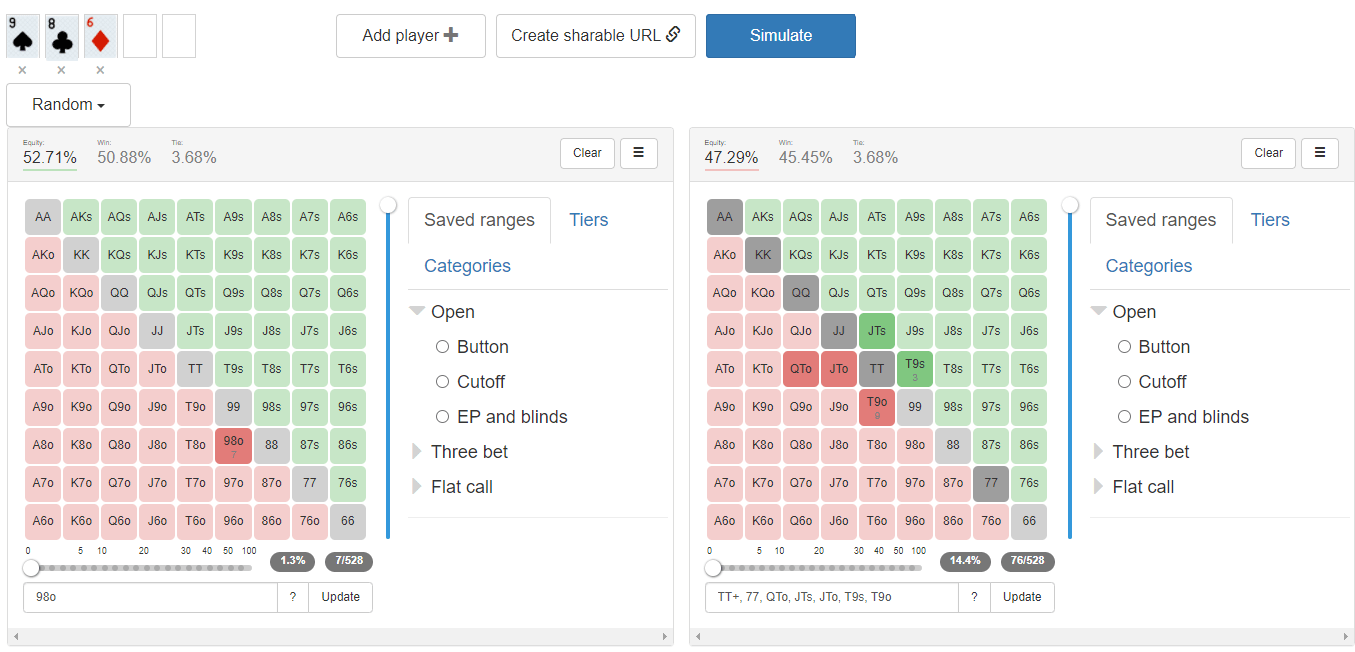
Scenario 2: 6-handed, UTG (100a) limps, UTG+1 (100a) limps, everyone folds to Hero on the BTN with 50 ante stack. We check with 89

Flop is 689 rainbow. 

UTG leads for half pot, UTG+1 calls, Hero ? 

This looks like a similar spot. Two pair with a possible straight out there, but if we look more closely, this is a much better spot for us for two reasons – our stack size and our range advantage. UTG position has the lowest VPIP, so we can safely remove A7o and T7o. Same goes for UTG+1. Of course, a recreational player might always play T7o, perhaps that’s his lucky hand. Generally though, UTG and UTG+1 won’t have many straights here, especially after UTG+1 just calls. Our hand is also blocking sets, so their range is going to be pocket pairs, JT, T9 etc.

So what’s our play here when we have 50 antes? It’s an easy allin. UTG might fold hands that do ok against our hand (TT, JT, JJ,77 etc), because while he might be okay with getting it in against us, he has to be a little careful considering UTG+1 might also call. So in this scenario we will often take down a 15 ante pot when both opponents fold (a 30% increase to our stack without being allin), and if we do get called, we will rarely be dominated.

Summary:

  1. Play cautiously with bottom two pair, especially on a very draw heavy board where our opponent could have a better made hand e.g. straight or a strong draw that is doing very well against us.
  2. There are situations where you should fold bottom two pair on the flop to a single bet, if you have players behind you, who could dominate your two pair or flopped a straight.
  3. Pay attention to the stacksize and board structure. You can much more likely stack off with 50 ante on a board that doesn’t hit villain’s range and also puts other players with deeper stack sizes at risk, such as multiway spots with more players involved on the flop.